

Why organic cotton is only the beginning
Organic cotton is a meaningful place to start.
But for a child’s first layer, the question cannot stop there.
Cotton still has a long journey before it becomes something worn close to the body. It becomes yarn. The yarn becomes fabric. The fabric is dyed, finished, brushed, cut, sewn, washed, and finally felt by the child wearing it.
Every step changes the final feeling.
This is why two fabrics can both begin with organic cotton and still feel completely different. One may feel thin, rough, loose, or easily stretched out. Another may feel soft, steady, breathable, and quietly secure.
At Duulaia, organic cotton is not treated as a finished promise. It is the beginning of a more considered process.
We look beyond the fiber itself and into the way it becomes fabric. The yarn, the texture, the weight, the softness, the recovery, the stitching, and the way it rests against the body all matter.
Because children do not experience a label.
They experience the fabric.
And the first layer should feel right before it ever needs to explain itself.
What GOTS means
GOTS stands for Global Organic Textile Standard.
It is one of the most recognized standards for textiles made with organic fibers. But what matters most is this: GOTS does not only look at the cotton as a raw material. It follows the textile through a larger journey, from harvesting the raw material to environmentally and socially responsible manufacturing and labeling.
That distinction is important.
A fabric can begin with organic cotton, but the cotton still needs to be spun, knitted, dyed, finished, sewn, and handled before it becomes something a child wears.
GOTS helps create a stricter framework for that journey.
It includes requirements around organic fibers, environmental responsibility, chemical inputs, social criteria, processing, and labeling. In simple words, it gives us more than a beautiful claim. It gives us a standard that can be checked.
For Duulaia, this matters because our pieces are made for close contact with the body.
Especially underwear.
The quietest layer should not rely on vague promises.
It should be made with a level of care that can be traced.


WHY THE YARN MATTERS
Before cotton becomes fabric, it becomes yarn.
It is one of the quietest parts of a garment, but it shapes almost everything the body feels.
The smoothness.
The softness.
The strength.
The way the fabric holds its shape.
The way it moves.
The way it washes.
The way it rests against the skin.
This is why fabric quality cannot be judged only by the word “organic.”
The same organic cotton can become very different fabrics depending on how the yarn is made. A yarn that is uneven, rough, or loosely constructed may create a fabric that feels less refined, even if the cotton itself began as organic. A more carefully developed yarn can create a fabric that feels smoother, steadier, and more comfortable against the body.
At Duulaia, we care about the yarn because children feel the result directly.
They may not know why one fabric feels better than another.
They may not have the words for texture, recovery, or finish.
But their bodies notice.
That is why our fabric development begins before the fabric itself.
We look at how the cotton becomes yarn, and how the yarn becomes the first layer a child wears closest to the body.
Because softness is not only something added at the end.
It begins much earlier.
FROM YARN TO FABRIC
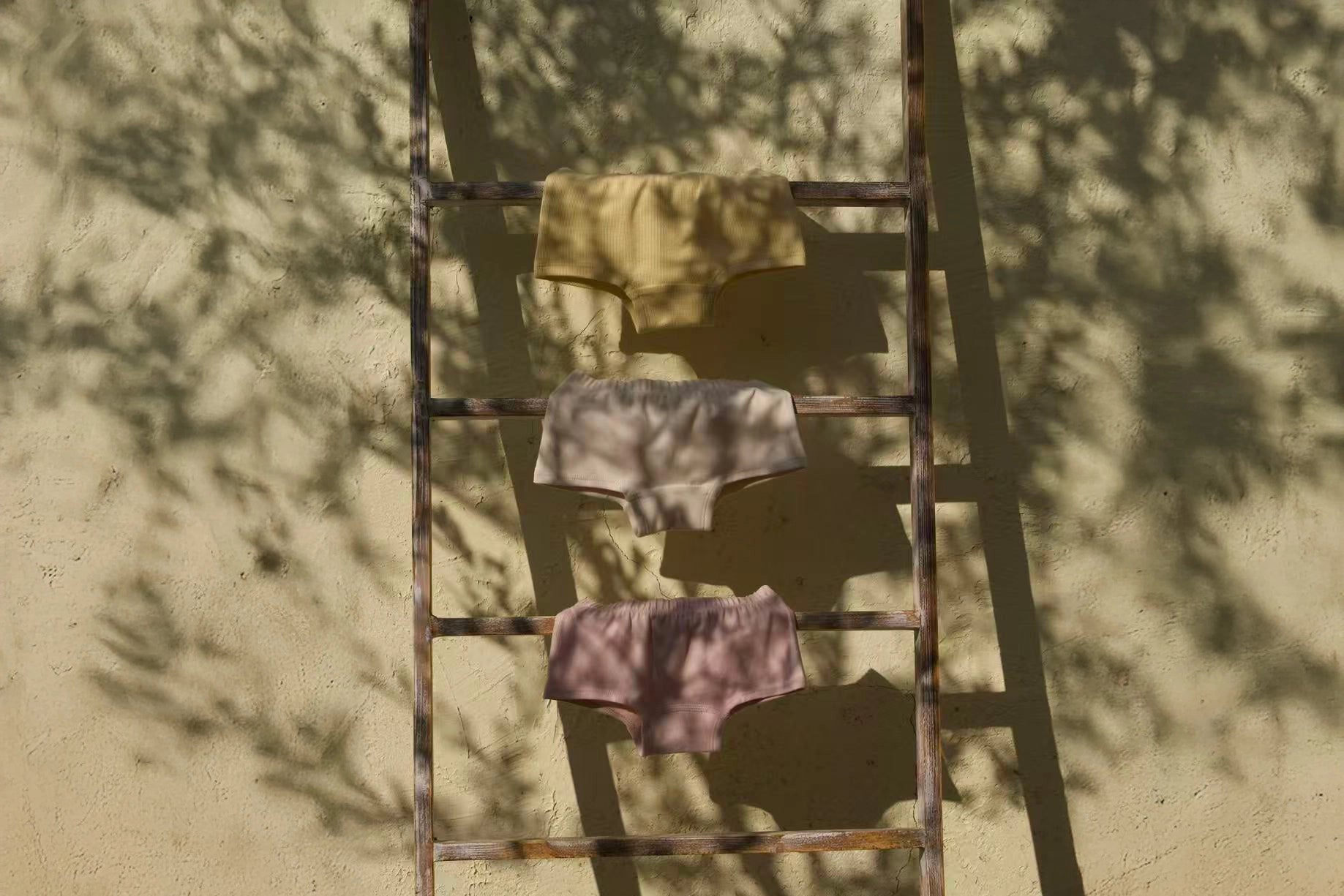
Once cotton becomes yarn, the next question is how that yarn becomes fabric.
This is where structure begins.
The same yarn can feel different depending on how it is knitted, how dense the fabric is, how much weight it carries, how it stretches, and how it returns after being worn.
For a child’s first layer, this balance matters.
If the fabric is too thin, it may feel delicate but not secure.
If it is too heavy, it may lose breathability.
If it stretches too much, it may not hold the body well.
If it holds too tightly, it may no longer feel easy.
At Duulaia, we look for the quiet middle.
Softness with stability.
Breathability with coverage.
Comfort with gentle hold.
A fabric that feels close, but never loud.
This is why fabric is not simply chosen.
It is developed, tested, adjusted, washed, touched, worn, and felt again.
Because the first layer should not only feel soft in the hand.
It should feel right on the body.
CLEAN PROCESSING
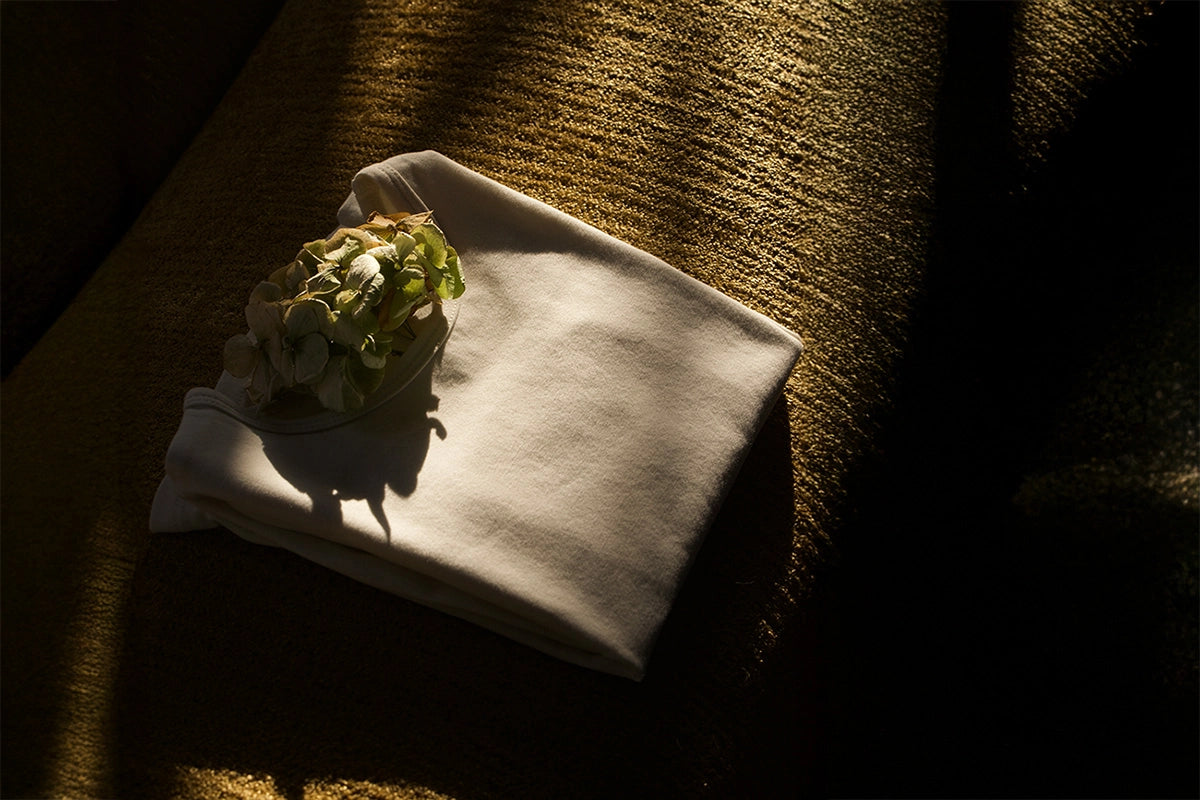
We select low-impact dyes and gentle finishing. Fabrics are tested for softness, breathability, and durability—so they feel good from day one, and day 101.
- Low-impact dyes / fewer auxiliaries
- Enzyme/steam finishing (where possible)
- No harsh chemical softeners required